Summary
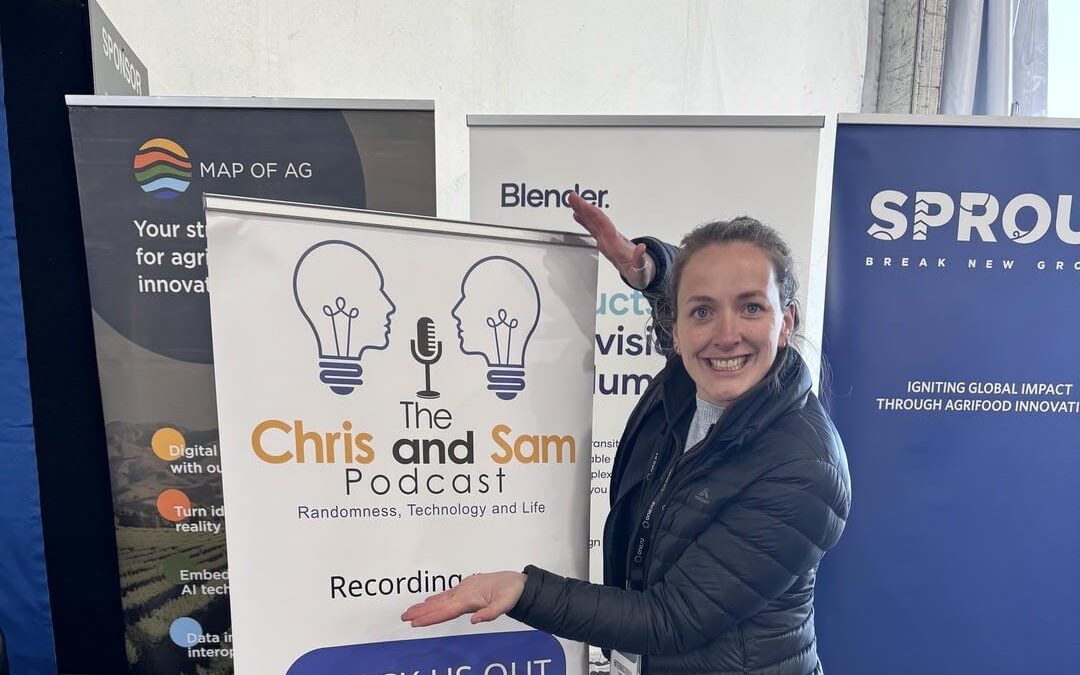
At Fieldays 2026 Sam catches up with Ali from Mid Wales, who's part of a global incubator program supported by Innovate UK and Sprout.
We dive into spray drying, microencapsulation, and turning agricultural and animal waste into high-value products like fertiliser. There’s talk of food security, waste valorization, and unexpected Olympic sports.
Farm visits, New Zealand connections, and the challenges of liquid waste management.
Links
Show Notes
This transcript was generated by an AI and may not be100% accurate. It pays to listen to the podcast, but if you have questions about any of the information found here, please reach out to us.
Sam [00:00:21]:
Okay, I'm here at the Innovation Tent again for field days 2026 and I'm here with Ali. She's come all the way from the UK to talk to us. Not me specifically, but with the Sprout delegation. I don't know what the actual term is for your delegation. What's the official title? Do we know?
Ali [00:00:40]:
I think it's we're part of the global Incubator program supported by Innovate UK and Sprout.
Sam [00:00:45]:
That sounds amazing and I believe you. That's the main thing. Now you've got a business or company, I guess. Or we're going to discuss that now. How do we pronounce this?
Ali [00:00:58]:
It's Cleobury.
Sam [00:00:59]:
Cleobury. And it's C L E O B U R Y. Perfect. And you're from Mid Wales, UK is where you're based. And it says here that your core focus is waste valorization. Hope I said that right. Spray drying microencapsulation, which we all enjoy and they turn agricultural organic waste and liquid effluent and high value stable powders.
Ali [00:01:21]:
Exactly that. So we specialize in identifying waste that has value. It can be for human consumption, it can be for animal feeds or fertilisers. And we take liquids which are largely a problem for things like storage, and they're changing all the time chemically and we turn them into a really stable powder that can be consumed or sometimes we agglomerate it into granules or pellets and we're here at the moment focusing on fertiliser.
Sam [00:01:48]:
That sounds all very good. It all makes sense to me, a non farmer, not really in the industry. But before we get to all of that, what's your backstory like? How do you get to where you are here in New Zealand talking to the Chris and Sam podcast, which is obviously the highlight of your 13 day tour. Where did it all start for you?
Ali [00:02:06]:
Well, Mandy and I have a background in biochemistry and human science and food, so we're the co directors of the company. We met at university and our jobs at the university at Aberystwyth in Mid Wales, where we run human trials based on functional food. And what we learned during that time was actually a lot of this food that we were running in clinical trials hadn't been optimized, so it didn't have the highest amount of whatever we were wanting it to have. So we started looking at food processing and how processing changes the composition of different foods. And we discovered spray drying, which is. I'll give a bit of an overview. I make the assumption everyone knows about spray drying because it's the best process in the whole world.
Sam [00:02:54]:
Of course, we all know that when we're talking about processes and things. That is the best.
Ali [00:02:58]:
Yeah, absolutely. So it's basically really simple process where you take a liquid and you take it to the top of a tower and you spray it into a really fine mist, atomize it and you apply some heat and all the liquid is evaporated off, all the water evaporates off and it leaves the solids to drop to the bottom. But in turn, you can encapsulate so you can add different things that create films so that things aren't lost. So vitamins that are sensitive or volatiles that are sensitive don't just disappear and we can keep them. So we discovered this process and we saw a business opportunity working with companies to develop their products for them.
Sam [00:03:35]:
Very cool. I see. So you're sort of in the processing space and then partnering with other companies and they could be have a wide range of products, I'm guessing.
Ali [00:03:45]:
Yeah. So we all start. We started this doing contract work. So a company wants to take some vitamin C and put it into their product. But actually, as time went on, we, we started really focusing on waste streams and by products and. And we have so much waste even before it even leaves the farm. You know, fruit, vegetables, all sorts. But actually, can't we look at different processes to extract the health benefits from those and create really valuable products, ultimately keeping profit on farm for the farmer? And you know, we all struggle with food security.
Ali [00:04:21]:
Every country's focus on food security, but also farming, no subsidies, lack of subsidies changing and things like that. So that's where the focus has been.
Sam [00:04:29]:
Seems like a massive area of growth or a great area to get into. How early are you in this industry compared to other places either in the uk, here in New Zealand or around the world?
Ali [00:04:42]:
So we're only a couple of years old and we've come into a process that's already very established. The spray drying is established all over the world. What we're doing is applying spray drying a little bit differently to other people. And as far as the fertiliser application, which is why we're in New Zealand at the moment, we're exploring the problem of liquid effluent on dairy farm and turning that into a fertilizer that is completely stable and recovering the water in turn. That process we're Quite early. So we've spent the last 18 months exploring our options at very small scale and now we're at the point in the UK of scaling that up on farm and then seeing where it could be benefit all over the world.
Sam [00:05:22]:
Very cool. So the waste streams that you mentioned, I think you have just answered it for me because I was going to ask if it was just food or that type of byproduct, but it seems like animal waste could be in there as well. Have you thought or looked into like wastewater plants?
Ali [00:05:40]:
Yeah, it comes up all the time, like the. I think our mass liquid waste from humans, from animals, from. Is a problem everywhere. And as regulations change, obviously protecting our rivers, that's a really big conversation. Certainly here the past few days I've been talking about protecting our rivers. And although Mandy and I are exploring animal waste on dairy farm, that's obviously massive here, it's massive at home. There's no reason why we couldn't explore this application in lots of avenues and certainly in Europe, we've been doing a lot of work with anaerobic digestate. So the liquid coming out of the digester, which is really kind of fitting to Europe, but also food waste here and digestion here, not so much the dairy waste in anaerobic digestion in New Zealand.
Sam [00:06:29]:
But yes, we sort of. I work sort of in the side of wastewater systems in my day job and I know that a lot of the solid waste at the plant here gets turned into fertiliser. We've got a big company that takes all. All of that and then creates it for food scraps. Here in the Waikato, there is a really large company that takes a lot of food waste and I think they're even taking out of Auckland and they're turning that into a. Yeah, fertilizer. Another fertiliser company. So there's a lot there.
Sam [00:06:58]:
But we do have different methods of what we're doing with the liquid waste here in New Zealand. So here it gets treated and then put back into the river, Waikato river in Rotorua, it's getting sprayed out to forest, to land. But there's definitely huge areas of improvement.
Ali [00:07:16]:
Yeah. And I think what we see a lot is even when there's a system in place, so here you can put so much liquid out on the land each day, and that all correlates with how wet or dry the land is and things like that. But ultimately what we're all doing is we're taking really dilute nutrition and we're spreading huge volumes of liquid in order to get that onto our farms and fields and forests and back into our rivers. Whereas actually in that liquid there's about 4% if that solids. So if we can recover the water from that and use it for irrigation or for wash down or for use on farm and that stable powder can be used for precision fertilization. It in turn reduces any need for a pond and in turn reduces the kind of pressure on synthetic fertiliser. So if we can use that nutrition as an actual targeted fertilizer, we're kind of a winning, aren't we? Because it's so useful and we use it because we need to get rid of it. We don't use it because it's really useful nutrition and it is useful nutrition.
Ali [00:08:23]:
It's just in the wrong format.
Sam [00:08:24]:
Yeah, that's true actually. It's really good. Now you're in New Zealand, you're touring around. Where else are you going apart from field days?
Ali [00:08:31]:
So these two weeks we're largely in the north island so we started in Auckland, we're down here in Hamilton at the moment. We're going to Palmerston North I want to say.
Sam [00:08:41]:
Yep, that's a place.
Ali [00:08:42]:
And so we've got a few different visits to farms and universities and ultimately looking at, you know, where our technology might be useful. But we are back in October where we'll have the kind of opportunity to do a lot more traveling. So if you or anybody thinks there's somewhere we've got to go or somebody might be interested in our technology, we also want to know about it.
Sam [00:09:04]:
Sounds awesome. Highlight of your trip of New Zealand so far?
Ali [00:09:09]:
I think the highlight has been, well, the interest in the technology and that's what we're really here for, but also the just the sharing of information. I think the benefit of New Zealand is people know people, which is phenomenal. So I go and see one person who has been amazing and helps me out and they have had connections to 10 other people and it's just that the connection and the benefit of we've been looking at, we've been doing our desktop research at home about policy and farming systems in the uk, in New Zealand, from the uk. But in reality nothing translates like being on the ground and being able to talk to farmers and somebody saying your technology sounds great but have you thought about this or have you thought about this? And we want to make sure this fits for people so there's nothing like being here.
Sam [00:10:00]:
Have you had any pushback from anyone? I don't know what that pushback would be but
Ali [00:10:07]:
we haven't had pushback so much as suggestions of what needs to be involved in our process to make it useful, which actually is just helpful for us, really. We didn't originally have a water recovery built into this system when we were first designing it. And I think that the kind of the conversation around we've got to be able to recover the water. The water is such a useful resource. And as our climate changes and as life progresses, recovering that water is of really kind of paramount importance. So I think we've had real suggestions of if you don't do this or abide by this, then your technology might not be as useful as you think it will be. That is very useful to us, to be fair. We haven't had pushback as such, kind of negative feedback as such.
Sam [00:10:56]:
No, no, I wouldn't expect you would because the idea is solid, it makes sense and people want to do the right thing. So it's really good. Here in New Zealand, we actually. You know how you have 6 degrees of separation? It's 2 degrees in new Zealand. So you just mention someone's name and somebody probably knows who you're talking about. So that's pretty cool. Hey, something I didn't mention before we started this, and I probably should have. We have a tradition at our podcast.
Sam [00:11:17]:
I'm going to show you two random questions unrelated to anything, really, and you get to pick one and answer it. But I just need you to read out which one you want. So they're the two that you can pick from.
Ali [00:11:27]:
Do I need to read them both out?
Sam [00:11:28]:
No, just the one that you want to answer.
Ali [00:11:32]:
What's a mundane task that you genuinely feel should be considered an Olympic sport? Well, I don't believe it's mundane, but the rest of the world might, which is drying things. I think drying things should be an Olympic sport. I think you should have to compete in choosing a drying method of a liquid that you have to retain all the nutrition, and the person that retains the most nutrition wins the Olympic sport.
Sam [00:12:00]:
Hey, they're doing interesting things in the world. There's the World Sperm Racing Championships are happening soon. You just had the. The. What's the Olympic one where they're all jacked up on drugs, so, you know.
Ali [00:12:12]:
Oh, enhanced Games.
Sam [00:12:13]:
Enhanced Games is the one. So, you know, it'll get there.
Ali [00:12:15]:
Yeah. And I cannot wait for the day I'll be at the front of the queue. At least unlike sperm racing. At least with the drying you can train and practice your craft.
Sam [00:12:25]:
Yeah, it makes a lot more sense. Exactly. Hey, where can people find out more about you if they want to get in touch.
Ali [00:12:32]:
So we've got a website www.cleoburypm.com and that gives you a bit of information. Our contact details also on LinkedIn. Alina Warren-Walker. But I would if anyone's got any ideas or they think we should be doing something that we're not, or they've got some ideas or they think we could be useful to them, we would love to hear.
Sam [00:13:02]:
That's awesome. We'll have all the links, this audio, the show notes and everything all on our website. So thank you so much, Ali, for taking the time to talk to us today.
Ali [00:13:10]:
Thank you so much. I'm really grateful.
Sam [00:13:12]:
No worries.
Where you can find us
Get Patreon Perks
Our Facebook Page
Visit us on Instagram
Chris’s Website
Sam’s Website