
Summary
In this episode from Fieldays 2025 we dive into the world of sustainable farming with Dugald Hamilton and Jeff Brown from RespondBio.
Discover how they’re shaking up agriculture by bringing living ecosystems back into our soil — and hear why farmers are finally “leaning forward” to listen! If you’re passionate about innovation, science, or simply want food that’s better for people and the planet, this one’s for you.
Listen now and join the conversation.
Photos
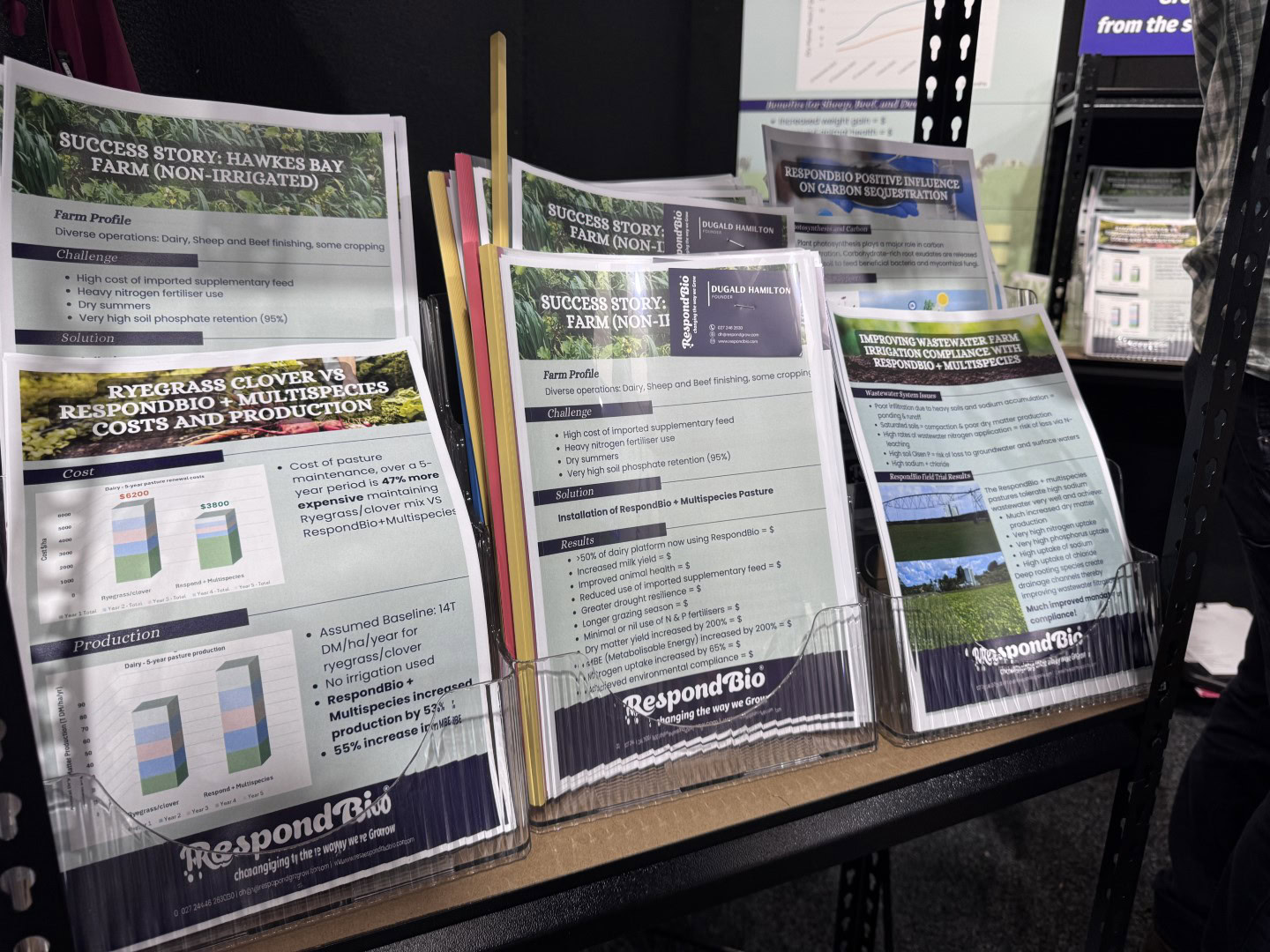
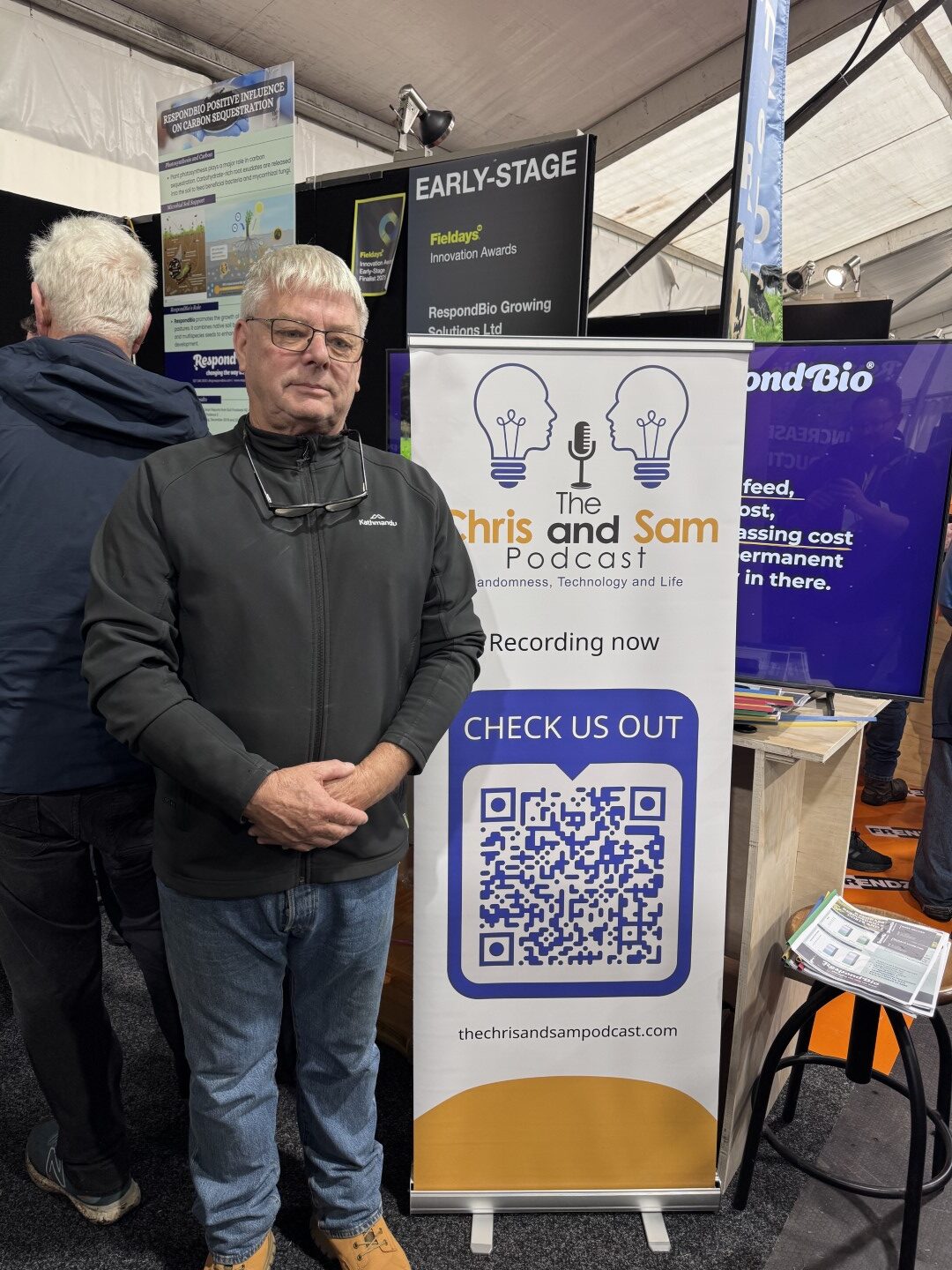
Links
Show Transcript
This transcript was generated by an AI and may not be 100% accurate. If you have questions about any of the information found here, please reach out to us.
Intro [00:00:06]:
Welcome to the Chris and Sam Podcast. Pull up a bar stool and join us for a random conversation guaranteed to make you think, earn your money back.
Chris [00:00:21]:
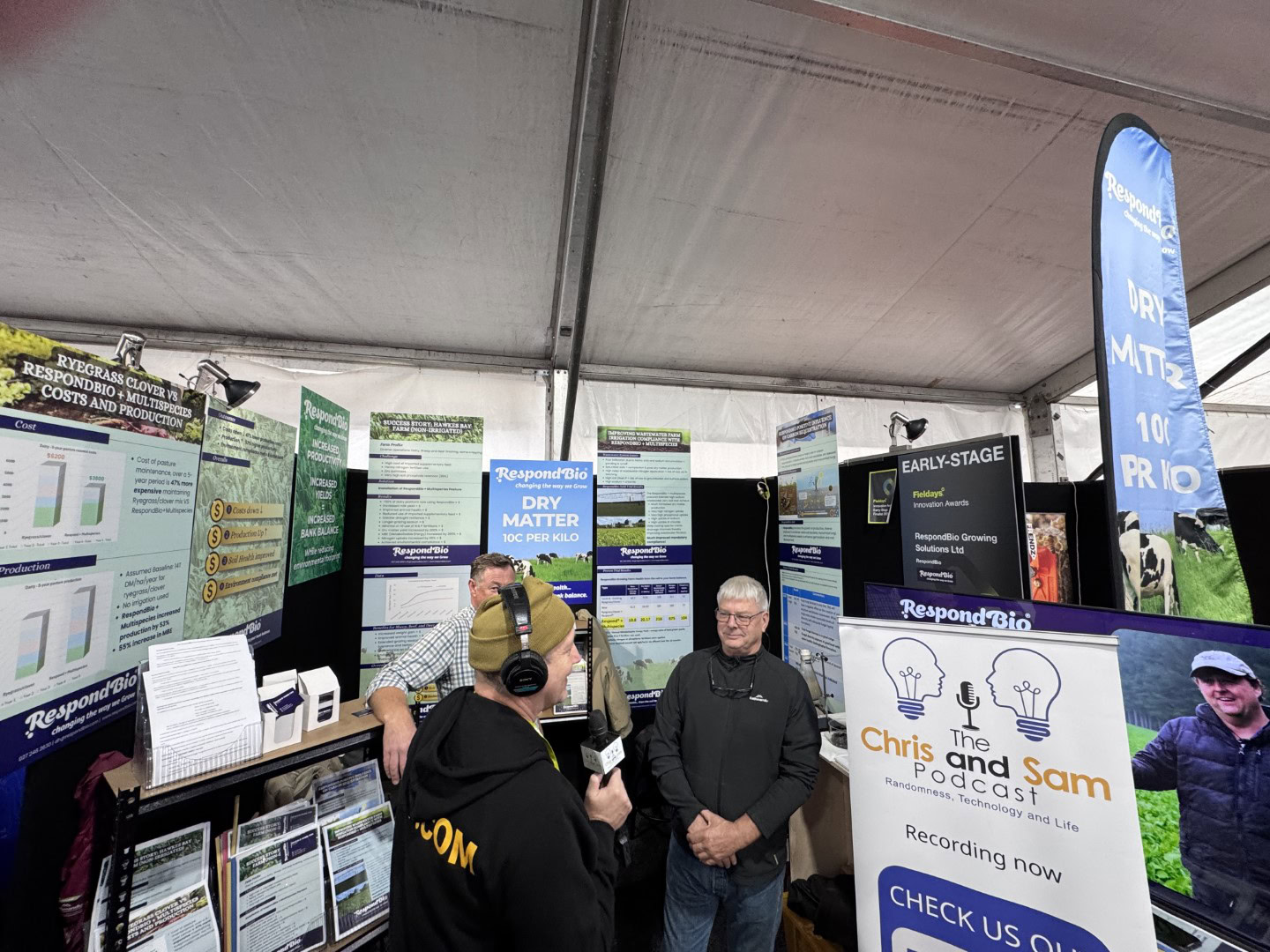
We’re in the innovation tent still, and I’m here with Dugald and I, we’re at Respond Bio, and I actually have no idea what we’re going to be talking about here. So, Dugald, give us an introduction. Who are you and what’s respondbio all about?
Dugald [00:00:38]:
My name’s Dugald Hamilton and this is Jeff Brown. And we’ve got a product that I’ve been working on for the last 40 years to reduce the amount of chemicals and unnecessary products going into the soil and the food stream of what we eat.
Chris [00:00:54]:
Okay, that’s a big, bold vision, very audacious dream. How are you doing that?
Dugald [00:01:02]:
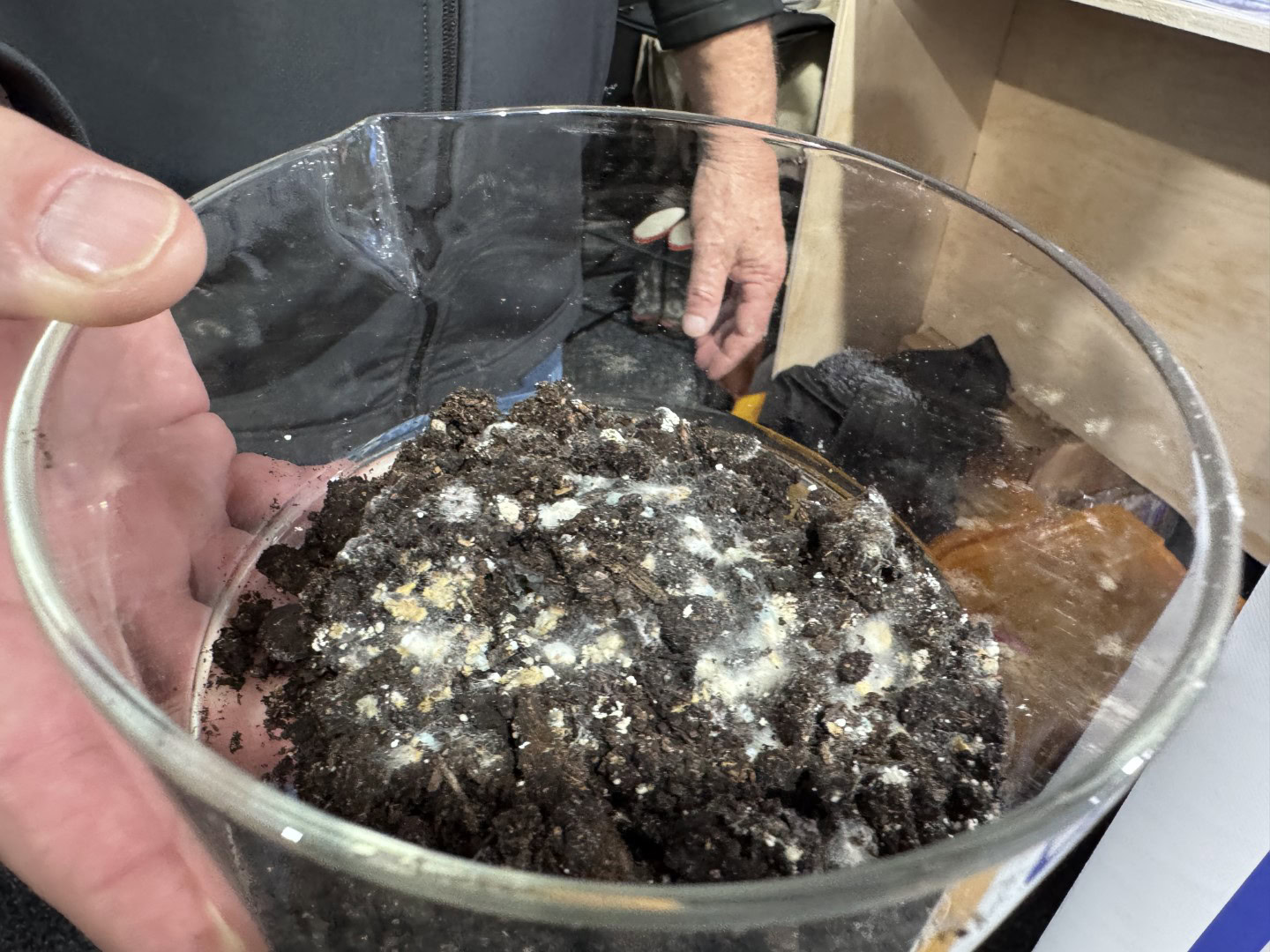
Well, what we’re doing is we’re going back to what worked for millions of years. We’re using strains of fungus and strains of bacteria to reproduce the necessary elements that farm pastures need for production. Once we get those biological products into the farm platform, the farmers find it very, very easy to maintain and progress because they’re all natural growers and biology and fungus need to be grown and need to be nurtured the same way their dogs, their cows, their sheep and horses and all the rest of the things that interact on the farm do. So, like, key to what we do is we’re not spreading expensive granules on the ground that dissolve. We’re installing living networks that multiply.
Chris [00:01:50]:
Okay, let me. Let me see if I can reframe or rephrase that or if I understand that. So instead of spreading fertilizer, which is an element that’s just added to the soil, you’re creating an ecosystem within the soil from the mycelium or the fungus and other bacterial things that the farmers can continue to feed that ecosystem. So it becomes more of a systemic way of doing the soil.
Dugald [00:02:22]:
We’re sort of returning the soil back to a default position that it once was. Soil is a living thing, and really, the ground that we walk on is the rooftop to another dimension. And what’s in that dimension? We have no idea. We can put machinery on Mars, but we don’t know what’s under our red beans.
Chris [00:02:41]:
Okay.
Dugald [00:02:42]:
So we’re just scratching the surface on that. And what we found so far is a huge way of being able to reduce the cost of production for farmers, putting more money in their pockets, but producing healthier food sources and lowering in environmental footprints.
Chris [00:02:59]:
Okay, so you’ve been doing this for 40 years, you say, yeah. Where are you on this journey. And what brought you to innovation Tent in field days, we’ve had a very.
Dugald [00:03:10]:
Successful round of investment. We’ve got some really key people on board now, with Jeff being our environmental scientist, Cameron Baggery and other advisors on how we move and how we approach things, and an investor that’s been able to give us the finances to achieve those steps and put them firmly in place. We have a lot of farmers now that are using our products and they endorse them 100%. We’re making some huge changes that probably, you know, Cameron says that we’re a successful disruption to what would commonly be the normal practice on a farm. And, you know, that’s exactly what we are. If we. If you take into account that we can grow dry matter for less than $0.10 a kilo in the first year and the second, third, fourth and fifth years after that, we’re down to 4 to $0.06. So instead of having to have additional feeds and expensive inputs, we now grow enough product on farm that can be grazed.
Dugald [00:04:14]:
And once it’s grazed, you reduce the cost of application, you reduce the cost of storage, input, transportation. You’re growing it, you’re eating it, you’re milking it, or you’re all, you’re hanging it on the hook. This is where we’re getting to as we’re being able to produce a much more environmentally sensitive, with longer resistance to these weather conditions and things that we’re facing now on farm.
Chris [00:04:43]:
Okay, so whereabouts in that commercialisation journey are you? Do you have, I want to say production, but, you know, are you going out and offering something to farmers now or is that coming or where are you in that journey?
Dugald [00:04:57]:
We’ve got a lot of that in place. But because of our uniqueness and the lack of understanding in it, we’re always looking for new areas that we can get trial blocks in to actually demonstrate. Because we find that farmers tend to have a thing I call gumboot vision, where they look at everything by the height of their gumboot and how fast it bounced back and how much it grows. What we find is we get one paddock on a. On a farm, and that gives farmers enough assurance to get more and more, and then suddenly within three years, they’ve got 200 hectares.
Chris [00:05:30]:
Okay, so if people are listening to this and they want to be part of a case study, because it’s those case studies that are really going to sell it going forward, by the sounds of it. Is that what you’re looking for?
Dugald [00:05:41]:
Yes, but to be brutally honest, we want farmers with Bare paddocks on busy intersections that we can put our stuff in the ground with a sign and let people see it for themselves.
Chris [00:05:52]:
Okay. No, that sounds good. So if you fit that bill and you’re listening to this. Absolutely. Find out about these guys. Now, I’m going to change the pace a little bit here. We’ve got a little thing we’re doing this year that we haven’t been doing in the past. It’s our random questions.
Dugald [00:06:10]:
Random questions.
Chris [00:06:12]:
So you get to pick two questions and answer one of them. So in case one of them is a dud, you can choose which one you want. So pick two out of there. Yep. Chuck that one third one back in there.
Dugald [00:06:28]:
Okay. Can we answer it between ourselves?
Chris [00:06:31]:
You decide which one of those two questions you want. So have a read of both of them. Decide which one you want.
Dugald [00:06:36]:
What’s the best compliment you have ever received? Ashe Milka told me that he no longer has to worry about looking at feed ahead of himself. He had a great amount of confidence in what we were doing and the amount of grass we were growing ahead of ourselves. So he wasn’t living on the edge of the cliff hoping for rain to be able to generate that grass where the cows are going to go in seven days. He already had it growing on that farm.
Chris [00:07:01]:
All right. You need more compliments, bro. No, I’m just joking. That’s great. So what I’d like to do is tell us where people can find out more about respond bio, where you are on socials, websites, all that sort of thing.
Dugald [00:07:18]:
Respondbio.com is our website.
Chris [00:07:21]:
Yep. And any social media activity or are you going traveling around the country doing any events or anything like that at this stage?
Dugald [00:07:29]:
I’ll pass it to Jeff and he can talk about a trial that we have with A two in the South Island. He was one of the key people behind instigating that and it’s a great opportunity for us in another country. We have the product patented in New Zealand, Australia, Canada, U.S. russia, and it’s just about passed in Europe, Ukraine and India.
Chris [00:07:52]:
Oh, that’s really impressive. Okay, cool. So Jeff, is it?
Dugald [00:07:57]:
Yes.
Jeff [00:07:57]:
Jeff Brown. I’m the scientist behind for helping. My role is to put scientific claims to back them up, to have the.
Chris [00:08:06]:
Data to make sure that they’re real.
Jeff [00:08:08]:
Yeah, that’s right. Yeah. I started off as a skeptic being a hard environmental scientist. And it was probably after about the third planting that I decided that, heck, this really works. The bugs and the fungi in the soil really does grow better pastures.
Chris [00:08:26]:
Okay. And so how hard has it been for you to convince other hard headed farmers of this?
Jeff [00:08:35]:
Yeah, you’re up against it. One of the reasons for that is because in the trials you change more than one thing at a time. You’re adding the biology and often you’re adding a multi species pasture as well, generally cutting out most of the fertiliser or completely eliminating it. So it’s hard to design trials to, to show the effect of each of those different changes when you’re doing them all at once.
Chris [00:09:04]:
But in an ecosystem you sort of have to change the whole system. You can’t really just change one part.
Jeff [00:09:10]:
That’s absolutely right. But there’s a lot of older hard nosed scientists out there that say, but you changed three things. Yes. Because we had to.
Chris [00:09:21]:
Yeah, gotcha. Gotcha.
Jeff [00:09:22]:
It’s about studying different difference, having two systems running side by side.
Chris [00:09:28]:
Cool. And what, what was this that you’ve got going on with this case study or thing you’ve been doing recently?
Jeff [00:09:35]:
Yeah, so we have a partnership with a dairy farm down in Dunsandal and we were successful in getting some grant money from the synlay and a 2 sustainability fund. So there’s going to be some trials down there. We’ve got really good data. Lower north island and Hawke’s Bay and this will be extending that to Canterbury where you’ve got different conditions, different soils. Irrigation obviously get us a good toehold into the South Island.
Chris [00:10:05]:
Fantastic. Well, thank you both for your time today and good luck with field days. Has the response been good so far?
Dugald [00:10:14]:
It’s been outstanding. We’ve got a lot of farmers that are really looking for something to change too. Yeah. So what we find is, like Jeff explained, is that there’s a great deal of disbelief about what we can do, which is one of the most wonderful things, because when you’re standing with a farmer that’s three years into it, their whole farm’s changed. We have, we have guys that have farmed for 100, you know, the family’s farm for 100 years. And they’re looking at paddocks that they’ve never ever seen produce that quality of feed before in their history.
Chris [00:10:48]:
That’s great. And I think you’re in the right place because I suspect that the farmers that come into the innovation tent are looking for those sorts of innovations.
Dugald [00:10:57]:
Right. This is the first time in a long time that I’ve seen eyes open. There’s always been a degree of hope that there are products like this, but now they’re actually leaning forward and, you know, it’s been a hard road, and it always is. And the first one over the trench always gets blown. But, you know, it’s just that’s part and parcel with it. And when people are adamantly against something and they stand in it in their gumboots and they can’t find anything wrong, that’s a huge moment for us, that conversion moment.
Chris [00:11:27]:
Yeah.
Dugald [00:11:28]:
It’s just the realization that perhaps not that they’ve been misled, but perhaps that there’s a better way to do something and achieve more outcomes with one action.
Chris [00:11:39]:
Yeah. A bigger view. Okay. Well, good luck for the rest of the weekend. The week, whatever. And yeah, thanks for the exposure, mate. No worries.
Where you can find us
Get Patreon Perks
Our Facebook Page
Visit us on Instagram
Chris’s Website
Sam’s Website