
Summary
It’s Fieldays 2026 and there’s a new electric farm bike on the scene—the GalvBike. The conversation focused on why this tough, no-nonsense machine isn’t in the innovation tent, what sets it apart for dairy farmers, and how the team’s past experience shaped the brutal simplicity of the design.
A key theme that emerged was the value of validation from real farmers—and why the first production run is selling out fast. There’s advice for aspiring inventors and a random question thrown in as well.
Links
Photos
Show Notes
This transcript was generated by an AI and is may not be100% accurate. It pays to listen to the podcast, but if you have questions about any of the information found here, please reach out to us.
Chris [00:00:21]:
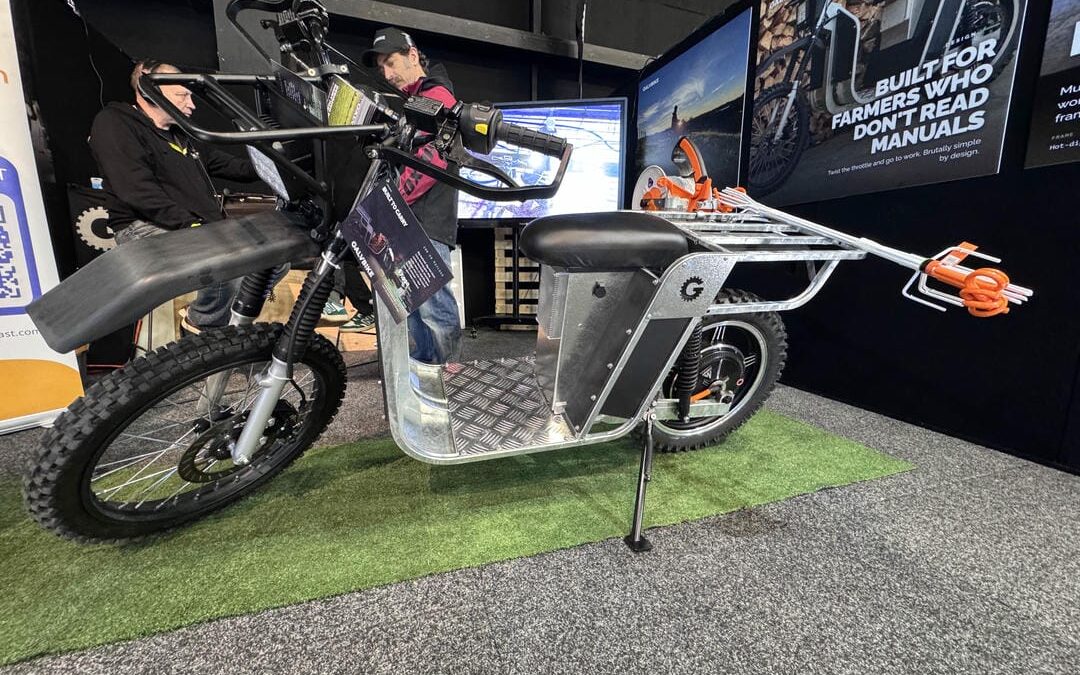
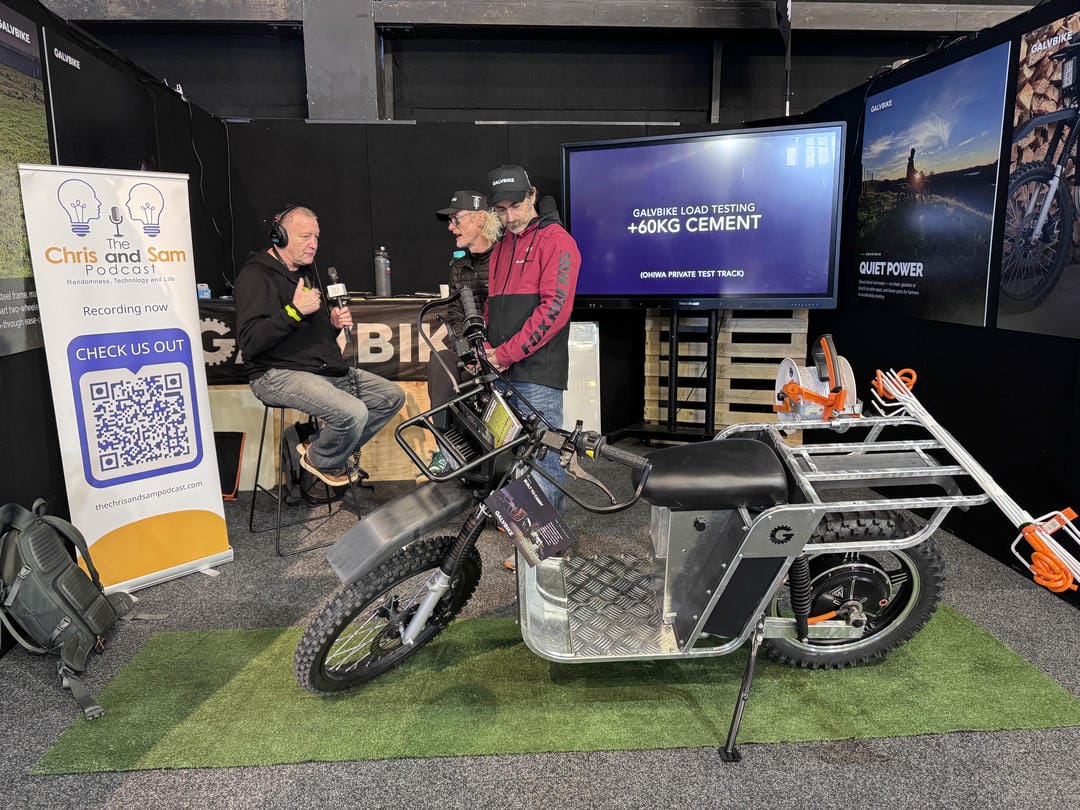
Okay, so here we are, field days 2026, and we're wandering around the main pavilion when we found something that, I don't know, I would have thought maybe it should have been in the innovation tent. But we're going to find out why it is not in the innovation tent, maybe. And it's called the Galvbike. So we've got a farm bike fairly, I want to say, I want to say basic construction because it seems basic to me, but I'm sure there's engineering in there and I'm with Daryl and Anthony and I'm going to ask them some questions. So, Anthony, what's the Galvbike all about?
Anthony [00:00:54]:
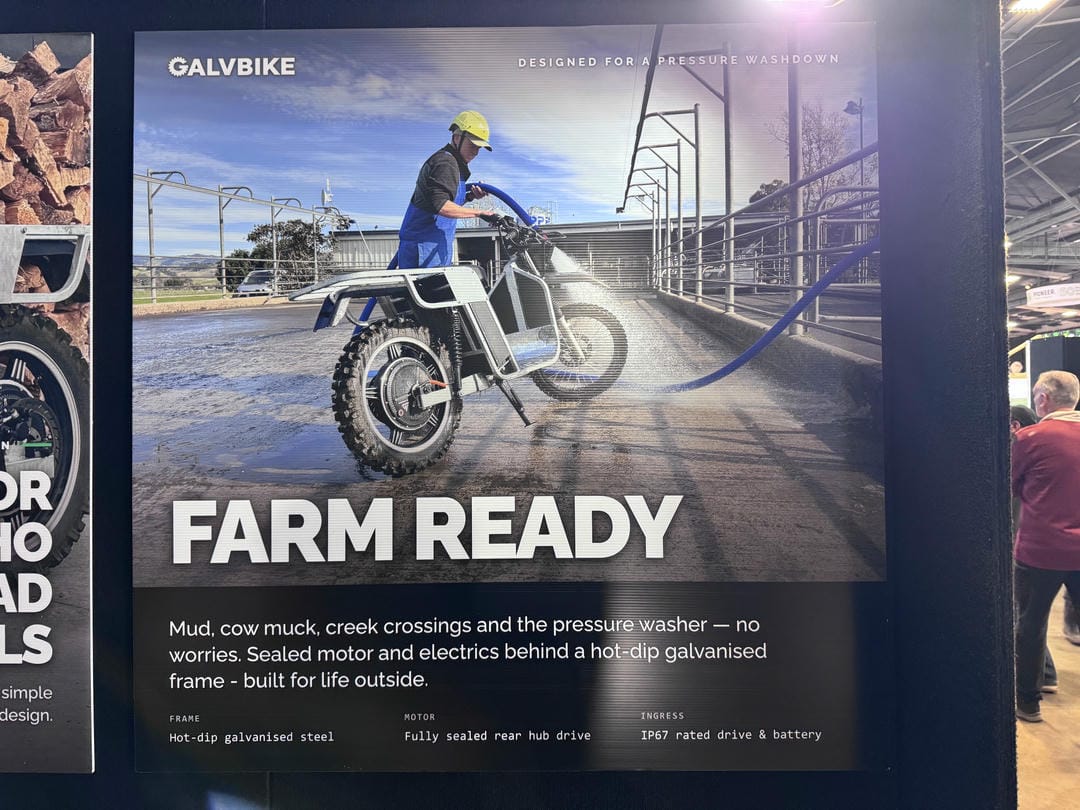
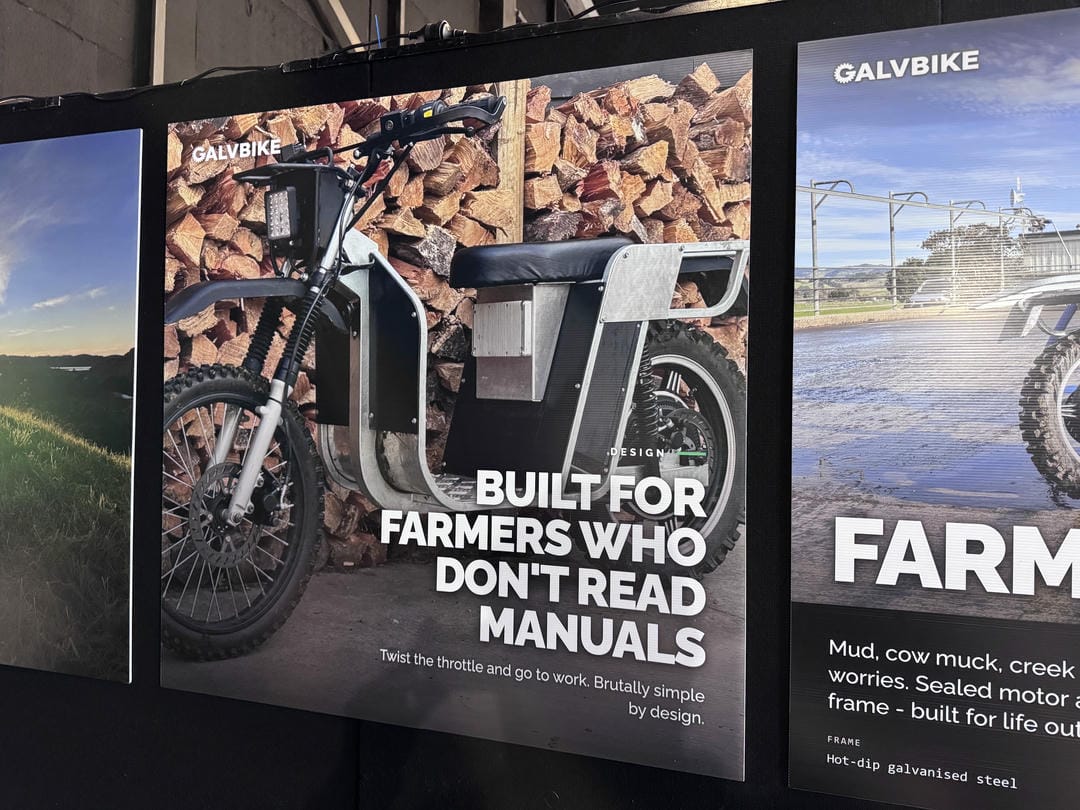
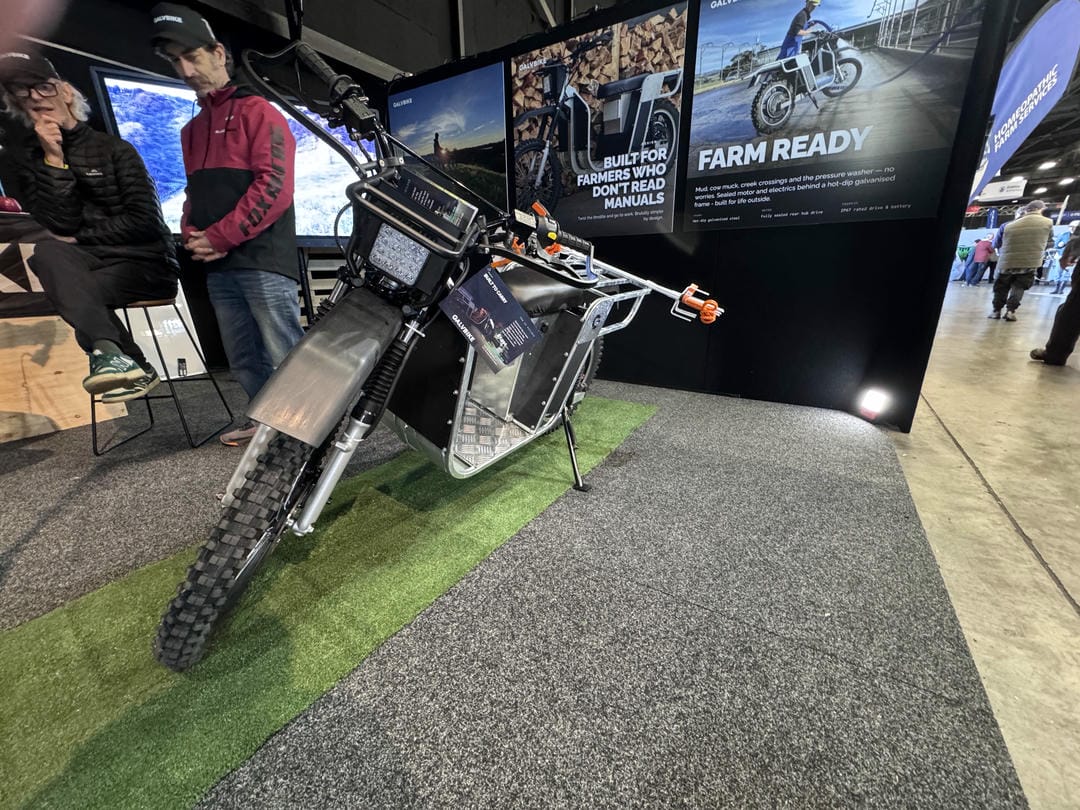
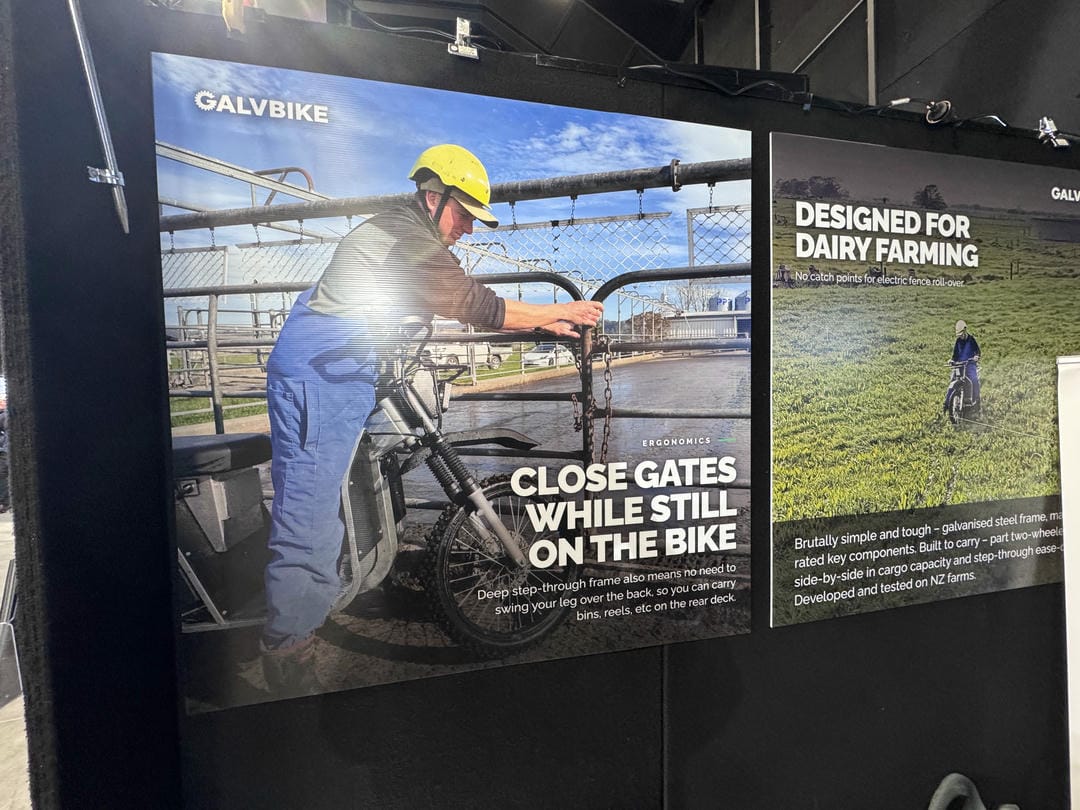
Yeah, well, you got it right. We're just brutally simple by design. It's designed for the New Zealand dairy farmer as our first customer. So we just stripped off everything we could. And then with electric it allowed us to go deep step through in the frame, which then means you can have a big tail on the back because you don't have to swing your leg over it. So it's brutally simple and it's designed to carry, so you can carry up to 100 kilos in the four front low step and then up to 30 on the tail. Simple on, off and then with all the components are a farm bike. So heavy duty.
Anthony [00:01:35]:
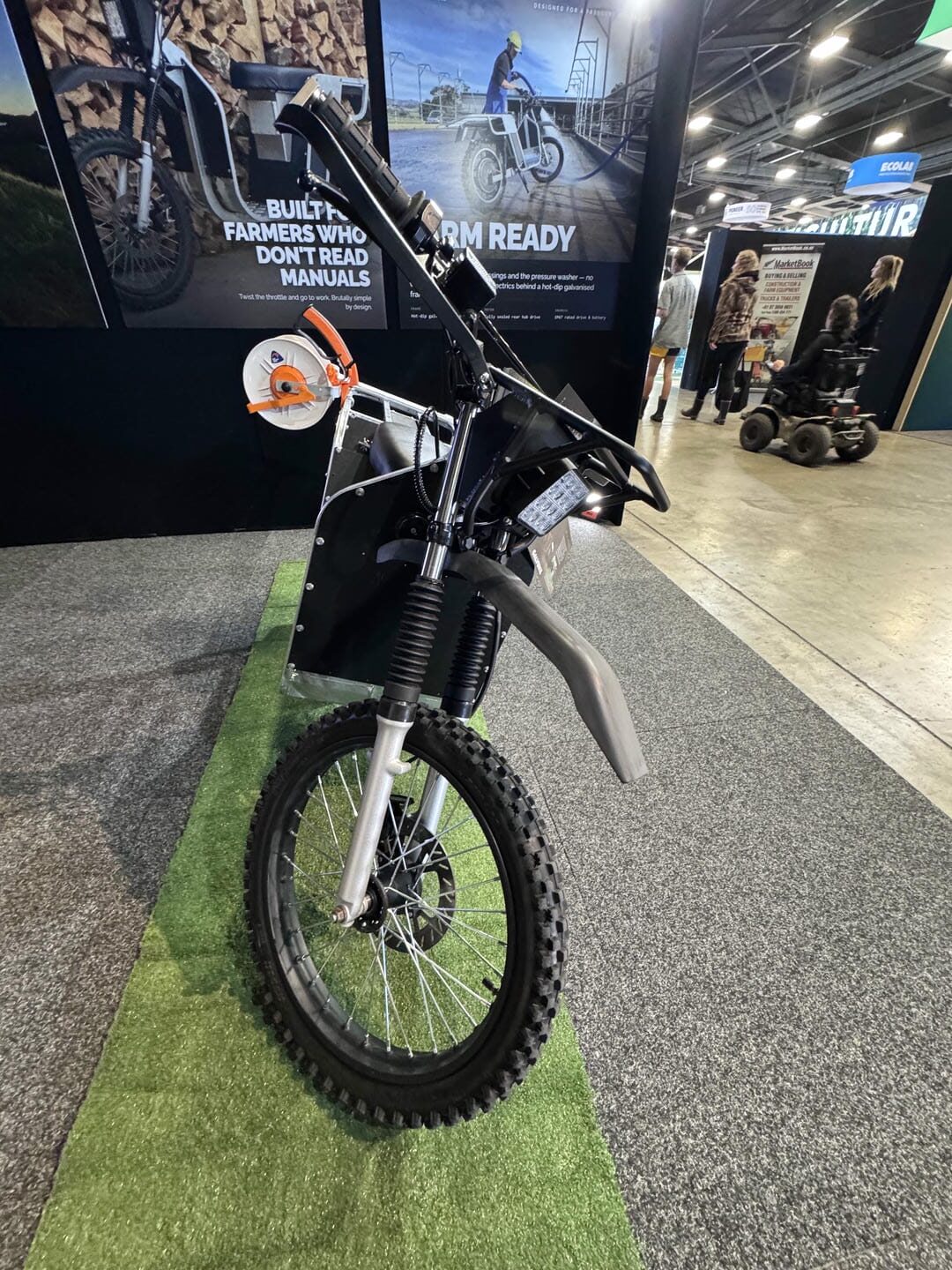
Brakes, rotors, shocks, springs, sealed bearings, ready to handle a high pressure hose down from a dairy farm.
Chris [00:01:45]:
Oh, perfect. And yeah, so it is a step through, like, I want to say like a motor scooter, but with the farm bike front and back wheels and the longest shocks, it doesn't look like a scooter at all, which is fine, but I can see why it would. So I've ridden bikes all my life. I can see why the weight in the middle makes a lot of sense there. So what is the benefit if you want to go there on being electric rather than gas powered?
Anthony [00:02:16]:
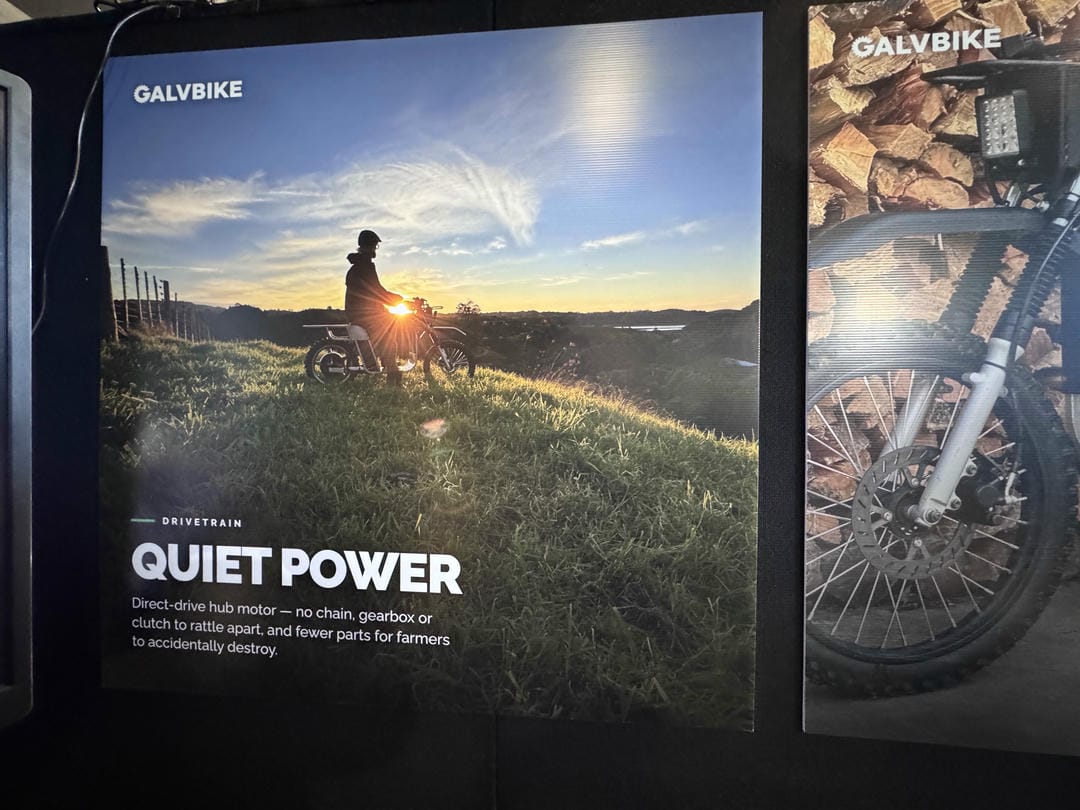
Yeah. The big one for us is without a motor and a fuel tank in the middle, then that enabled us to do the deep step through. And then as soon as you have the deep step through, you don't have to swing your leg over. So that gave us the rear cargo. Reverse is very easy. So it's got a reverse function and it's quiet. So just if you're a working farmer, you know, you can, in the morning you can literally just hear the tires squishing over the, the grass. Other benefits it doesn't disturb the stock
Daryl [00:02:49]:
and you can hear your electric fence when it's shorting out.
Anthony [00:02:52]:
It's not a service requirement because you've got regen braking, so you hardly need your brakes on a dairy farm.
Chris [00:03:00]:
Okay, so my normal question here would be what challenges have you faced getting this to where it is? But apparently there's a bit of a story here. So do you want to give us a bit of the story, whatever you can give us and let us know a little bit of your journey because it sounds fascinating.
Anthony [00:03:17]:
Yeah, well, Daryl and I, 2014, we entered our Steed electric farm bike in the innovation center and we, I just went to the awards dinner because it was free bacon and eggs brekkie and Richie McCaw was the MC, but we ended up winning two of the three main prizes and then that became UBCO, the two wheel drive fanboat.
Chris [00:03:42]:
So what was the difference between that bike and this one?
Anthony [00:03:45]:
Yeah, the UBCO we knew it had kind of two markets, urban delivery. And then we wanted to solve the dairy farm ready bike, but it was a smaller, more like a CT90, wheelbase in size. In the end, we're not involved in UBCO anymore and they've ended up focusing on the urban delivery, which kind of leaves the electric farm bike problem still unsolved. So there's. Daryl and I have been thinking this through for over a decade now. We've learned a lot and it's really just, it's a work tool so it cannot fail. So seals, bearings, brakes, simplifying the wiring, loom, stripping off everything that can break and fail.
Chris [00:04:38]:
Yeah, and I think so. It's as it says, Galbike. It's galvanized steel everywhere. So it's easy maintenance, I would imagine, very easy to clean, keep clean and keep going. And I do love the tail. I mean we'll have some photos with the audio here so you can have a look at that. But you can put, you can configure that for anything. Like you can put anything on that thing really at the back there, the
Anthony [00:05:01]:
farmers just to weld stuff on it, you know, bolt on. Like it's a platform that you can just accessorize as you need.
Chris [00:05:11]:
Yeah, absolutely. And you can see that. So what does one of these things go for?
Anthony [00:05:15]:
Yep, so they're just under 8,000, that's inclusive. Our first production run's underway now. We've already sold over half of our first production run in the first three hours. And then the next production run will be available later in the year. We Think we'll be sold out by tomorrow of this first release.
Chris [00:05:34]:
That is. I think that's amazing. Is that what you expected?
Anthony [00:05:38]:
We were hopeful, but this is the actual validation. And farmers get it. They just come in and go, yep, yep, yep, get it.
Chris [00:05:47]:
And 8,000 is not a big price. That's not a huge amount, particularly if it's, you know, like you say, it's a tool. And I would imagine this is a tool you'll be using every day. Pretty much, yeah.
Anthony [00:06:01]:
And when you factor in fuel savings and more importantly, service costs and off farm costs, it's. Yeah. Over its lifespan, it will pay for itself probably a couple of times over.
Chris [00:06:15]:
And for me, I think it's the right choice in terms of. As opposed to urban delivery. Urban delivery, you've got to be street safe, you've got to have your MOT or whatever you call it, your know, your warrant and fitness and all that sort of thing. Whereas this, I. I don't suppose that even matters.
Anthony [00:06:30]:
No, we just. We're not going there. So we're. We're farm only, so it's not road legal. The laws in New Zealand are easier than in many countries. So you're still allowed to go from farm to farm if you straddle the road. Yeah, we're just staying really focused on dairy farmers. And then the hunters are another market that's pretty excited by it.
Chris [00:06:54]:
Oh, yeah, yeah, I could see that. Yeah, absolutely. You get a pig on the back of that. Maybe. Okay, so in terms of the journey you've taken with both of your adventures here, what piece of advice would you give to somebody who's come up with an idea and they. And they want to pursue it? What are the things you want to look out for? What are the things you recommend they do? What do you think they recommend they don't do?
Daryl [00:07:23]:
Either of you stay. Stay small and stay tight while you get going. And try not to let your ego take over and grow so fast that you actually forget why you did it in the first place and complete the. The product or the idea that you've got. Make it work properly, make it work well, and then the rest of it will come after that. If you've got a good product, then they will sell themselves. You don't have to put effort into marketing. Your product should be marketing itself.
Chris [00:07:54]:
Well said. And I can. Yeah, that rings true to me. I haven't had the experience you've had. But the point is that you are getting that validation today. Right. If you've already sold half your quota, so far in the first few hours. So we were only on day one when we're recording this of a four day, of a four day field day.
Chris [00:08:17]:
Then you'll be sold out before we're halfway through. That's the, the best validation but also
Anthony [00:08:23]:
we've been very open to the valid. The real validation is over the next 12 to 24 months and we, you know we'll fully back them up. There may be some components or whatever that we two years in or 18 months and, and then we will for this first generation will upgrade them. You know that there's, there's no way to simulate farm use but farm use,
Chris [00:08:48]:
oh 100 percent, and I and I'm glad you mentioned that because you've got to stand behind your product. You're not going to go anywhere. You're not running off anywhere. This is a long term play. So and I can see that you've put a lot of work into the stand. The bike looks good. You know, you've got a great logo and what have you and you got the, you know wearing the caps and all the rest of it. So it's obvious that you've got, got your stuff together with this.
Chris [00:09:15]:
What would you want to say to anybody thinking about oh should I give it a go? Should I try it? What. What do you want to say to anybody with that sort of thought in mind?
Anthony [00:09:24]:
Well I think word will get around because as, as we sail through and farmers talk, you know if we. We're ba. Plenty based so we're keeping it pretty close to start with Waikato Bao. Plenty of. Yeah just search, search the reviews, do your research online. You know there'll be more and more content on us over the next sort of several months as people do post their responses. Our early pre trials, our first two trialers ordered one, you know and these are working dairy farmers who things we didn't realize because of the deep step through people can stand up close, they can open and close gates while still on the bike. And he was like holy hell.
Chris [00:10:07]:
Yeah, that's cool. And as we are talking here at least a couple of people have come over to see how heavier it is. Which yeah, you want to know what is the weight on that.
Anthony [00:10:17]:
Yeah. And that was another learning. So we're the same weight as like an AG one two five around 110. We found that the weight actually helps stabilize the bite especially over a dry like dairy farm rutted paddock. Yeah. So I was pushing our design team for more. I want more weight on the front and we've got a big 50x50 that runs through the whole mainframe. So it's super, super solid.
Anthony [00:10:46]:
But it is a. It's an easier weight because the weight is lower than on a standard farm bike and there's no fuel tank.
Chris [00:10:54]:
Yeah, yeah, that makes perfect sense to me. Okay, well, where can people find out more about Golf Bike if they're interested in what they're hearing about now?
Anthony [00:11:03]:
Yeah, just go to galvike.com that's G-A-L-V-B-I-K-E.com and you can contact us directly through there. We're based in the Bay of Plenty at this stage, but yeah, just reach out to us.
Chris [00:11:18]:
Do you have any social medias or anything like that?
Anthony [00:11:20]:
Yep, yep, we got Facebook. So if you. Again, just go bike on Facebook and we'll be. We're setting up a YouTube channel and getting some of our on farm footage and manuals. But we sort of kind of say it's designed for farmers who do not read manuals. So our manual, we're going to try keep it to one A4. That's our goal.
Chris [00:11:40]:
Yeah, that's, that's what cracked me up when Sam handed me the flyer for this and said, do you want to talk to these guys? I'm like, hell yeah. Was that whole made for farmers that don't read manuals? I was like, I like that, that already. I'm into this. Okay. We've got a bit of a tradition here where we ask a random question. He's got a random question randomizer. We're going to give you one to look. There's two to look at.
Chris [00:12:07]:
Choose which one, read out the question, then give us your answer.
Anthony [00:12:10]:
Oh, nice, nice. I quite like, even though I don't have an answer yet, if you could swap the physical sizes of two animals, which swap would cause the most chaos? Well, I reckon if you swapped, say if you want to cause chaos. Is plankton a life form? Like if I could swap whales for plankton, that would cause some serious biomass chaos.
Chris [00:12:35]:
Yes, it would. Yes, it would. I don't know who came up with that question, but yeah, no, that's good. Okay, well, thanks very much guys. I really appreciate that. Good luck with field days. Although I don't think you need luck. I think you are onto it with this thing.
Chris [00:12:49]:
Thanks very much too.
Where you can find us
Get Patreon Perks
Our Facebook Page
Visit us on Instagram
Chris’s Website
Sam’s Website